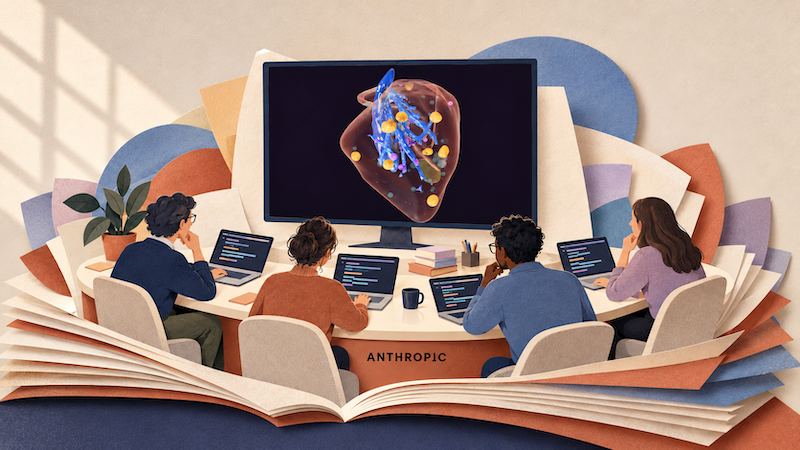
Miriam González is a software engineer and tech communicator from the Region of Murcia in Spain. In January 2024 she was diagnosed with metastatic breast cancer. Since April of this year, she has spent much of her time running a research project on her own case, with most of the work done by AI agents she built herself.
Her tumor is rare. It combines the hormone-driven biology of a common breast cancer with a neuroendocrine component, and Spanish treatment protocols only account for the first. Estimates of how often this type appears range from 0.1% to 5% of breast cancers, depending on the definition.
"My tumor has two sides — the breast side and the neuroendocrine one — and the key is to treat both at once, not just one," she said in May.
With a cancer this uncommon, the relevant research is spread across journals, trial registries and specialists in different countries. No one is assigned to gather it for a single person, so González set out to do it herself.
How Polaris works
She named the system Polaris and describes it as "a team of AI agents that works for me day and night, like a research team."
Some of the agents read published studies related to her tumor's biology. Others search clinical trial registries worldwide for studies she could join. The results are compiled into documents her doctors can use, including a full clinical summary written for specialists giving second opinions. Polaris also converted her scans into interactive 3D maps of her lesions, which she has published for her care team.
Much of the project is public. Under the name "Beyond the Protocol," González and a group of volunteers keep the code and non-sensitive data in an open GitHub repository, including tools for literature review, molecular profiling and trial matching.
Six months in
The bone map helped her doctors pick which lesion to biopsy. Earlier attempts to sample her bone metastases had come back without usable tumor tissue. A bone biopsy in July produced viable tumor, and for the first time her molecular profile came from tissue instead of blood.
She says the six months of AI-assisted research also got a test moved up and a biopsy done in Zurich, and that a team at Dana-Farber has joined to study her tumor.
People got involved too. In April she posted a thread on X about her case, and within days specialists from three countries had offered to help. The WIN Consortium, an international molecular tumor board, reviewed her case in May.
"I use AI to amplify my knowledge," she told El Español in June.
Her doctors decide
González keeps a firm line between the software and her medical team. "Polaris doesn't decide. They do," she wrote.
The lesion map on her site carries the label "Decision support, not diagnosis." Polaris handles the reading and searching, which would take more hours than any one oncologist has, and her doctors make the treatment decisions. "AI doesn't replace them — it helps me meet them halfway," she wrote on X in April.
Hitting the limit
The weak point turned out to be the AI service itself. "Right now, what's holding me back is the AI itself," González wrote. "I keep hitting usage limits, and when I do, the research stops."
Those pauses had a real cost. Her published timeline shows the cancer changing under treatment and spreading from her bones to her liver this summer.
She posted a direct request:
"So this is an honest ask, not a complaint. I need more AI capacity, specially Claude, and access to high-compute models and to models built for scientific research. If you work at an AI lab, or you know who decides these things, I'd really like to talk."
Anthropic's response
People at Anthropic saw the post and contacted her in the following days, she wrote on LinkedIn. She had applied to the company's AI for Science program, which gives API credits to researchers on scientific projects, with a focus on biology and the life sciences. Her project was accepted, and the credits are now in her account.
She thanked the people who shared her post, writing that the outcome "is down to everyone who read it and passed it on."
With the credits, her research no longer stops when she runs out of quota. "For now I'm back to building, and I'll share what comes out of it," she wrote.
She also noted the limits of the arrangement. "The credits expire, so it's breathing room, not a permanent fix," she wrote. Under the program's published terms, credits last six months.
Her case raises a broader question. AI companies cap usage because computing power is expensive. Meanwhile, people like González are building research systems on plans meant for ordinary use, and there's no standard way for them to ask for more. She got help after her post spread widely, and most people in a similar position won't have that reach.
How to help
Her site, helpmiriam.com, lists ways to help depending on your background. "I'm not asking for guarantees — I'm asking for opportunities," she told El Español.
Donations through her GoFundMe pay for tests, second opinions and care that Spain's public health system doesn't cover. The site publishes a breakdown of spending on its expenses page.
Oncologists and researchers can read the full case in the professional section of the science page and offer a clinical review.
Developers and people who work in AI, data or bioinformatics can contribute to the GitHub project or contact her team. Her credits are temporary, so she will need computing capacity beyond the next six months.
Sharing the story helps as well. Her request reached Anthropic because readers passed it along. She has said she wants rare cases to stop being footnotes and to "become data, studies, real options."